| Trajan |
 


  |
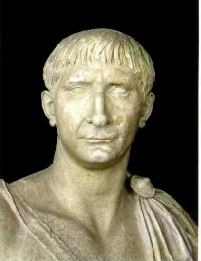
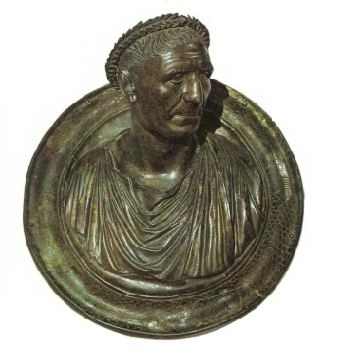 Trajan,
mit vollem Namen Marcus Ulpius Traianus, (53-117), römischer Kaiser (98-117),
der erste Adoptivkaiser im Römischen Reich. Trajan wurde in Italica (beim
heutigen Sevilla, Spanien) geboren; seine Familie stammte vermutlich aus
Rom. Unter den Kaisern Titus und Domitian nahm Trajan an den Feldzügen
in Spanien, Syrien und Germanien teil. Er zeichnete sich als Feldherr
aus, stieg 91 zum Konsul auf und wurde dann Statthalter von Obergermanien.
97 adoptierte ihn Kaiser Nerva und ernannte ihn zum Mitregenten.
Trajan,
mit vollem Namen Marcus Ulpius Traianus, (53-117), römischer Kaiser (98-117),
der erste Adoptivkaiser im Römischen Reich. Trajan wurde in Italica (beim
heutigen Sevilla, Spanien) geboren; seine Familie stammte vermutlich aus
Rom. Unter den Kaisern Titus und Domitian nahm Trajan an den Feldzügen
in Spanien, Syrien und Germanien teil. Er zeichnete sich als Feldherr
aus, stieg 91 zum Konsul auf und wurde dann Statthalter von Obergermanien.
97 adoptierte ihn Kaiser Nerva und ernannte ihn zum Mitregenten.
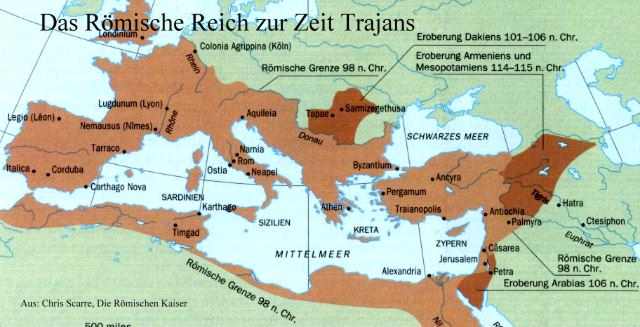
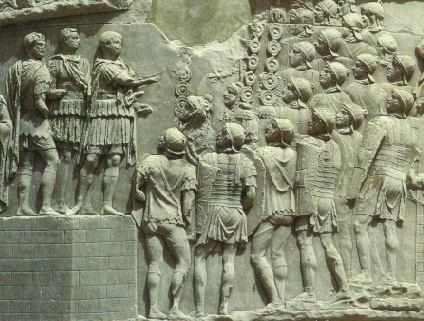
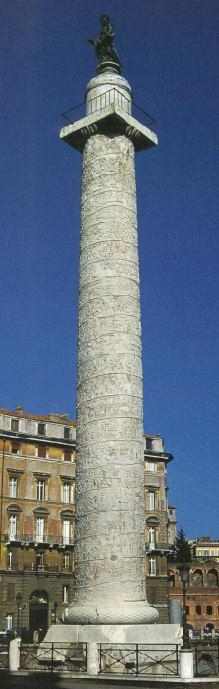
Nach Nervas Tod 98 wurde Trajan, damals gerade mit der Sicherung der Grenze an Rhein und Donau beschäftigt, alleiniger Herrscher im Römischen Reich. 101 nahm Trajan den Krieg gegen die Daker auf dem Balkan wieder auf. Nach zwei Feldzügen hatte Trajan das Dakerreich 106 schließlich unterworfen und machte es zur römischen Provinz Dacia. Dieser Erfolg wurde in Rom mit prachtvollen, 123 Tage dauernden Spielen gefeiert, und zur Erinnerung an den Sieg über die Daker wurde die Trajanssäule auf dem römischen Trajansforum errichtet (um 106 bis 113). 113 begann Trajan seinen Feldzug gegen die Parther im Osten. Er eroberte Armenien, Mesopotamien und Kthesiphon (bei Bagdad), die Hauptstadt der Parther am Tigris, und rückte bis zum Persischen Golf vor. Der jüdische Aufstand und neuerliche Angriffe der Parther zwangen Trajan 117 zum Abbruch des Feldzuges. Er starb auf der Rückreise nach Italien in Selinus in Kleinasien. Trajans Nachfolger als Kaiser wurde sein Neffe Hadrian.
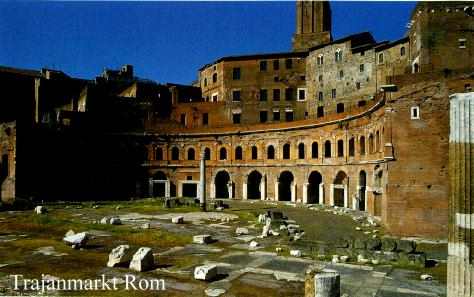
Innenpolitisch führte Trajan Nervas sozialpolitische Maßnahmen - die Versorgung armer Kinder, kostenlose Getreideverteilung in Rom - weiter und kümmerte sich, oft bis in die Einzelheiten, um die Verwaltung in Italien und in den Provinzen. Trajans reger Bautätigkeit waren zahlreiche neue Straßen, Kanäle und Brücken zu verdanken, der Wiederaufbau der Via Appia, die teilweise Trockenlegung der Pontinischen Sümpfe, das Trajansforum und die Trajansthermen in Rom sowie der Ausbau des Hafens von Centum Cellae (heute Civitavecchia). Unter Trajan erreichte das Römische Reich seine größte Ausdehnung.
 Trajan
(Latin, Marcus Ulpius Trajanus) (c. 53-117), Roman emperor (98-117), conqueror
of Dacia and Mesopotamia. He was born in Italica (near modern Seville,
Spain), of a family probably Roman in origin. He was trained as a youth
in the Roman army and took an active part in campaigns in Spain, Syria,
and Germany during the reigns of the emperors Titus and Domitian. Trajan
achieved distinction as a general of outstanding ability, and in 91 he
was elected a consul. In 97 he was adopted by Emperor Nerva as his colleague
and successor.
Trajan
(Latin, Marcus Ulpius Trajanus) (c. 53-117), Roman emperor (98-117), conqueror
of Dacia and Mesopotamia. He was born in Italica (near modern Seville,
Spain), of a family probably Roman in origin. He was trained as a youth
in the Roman army and took an active part in campaigns in Spain, Syria,
and Germany during the reigns of the emperors Titus and Domitian. Trajan
achieved distinction as a general of outstanding ability, and in 91 he
was elected a consul. In 97 he was adopted by Emperor Nerva as his colleague
and successor.
On the death of Nerva the following year, Trajan, who was at that time inspecting the Roman frontier in Germany, became the sole ruler of the empire. He did not return to Rome until several years later, however. He celebrated his accession by gratuities to his soldiers and also made provisions for the maintenance of the children of poor freemen in Rome and other Italian cities, thus continuing the system of governmental benevolence initiated by Nerva. In 101 Trajan set out on his first campaign against the Dacians in south-eastern Europe. The struggle was long and fierce, but by 106 the Romans had completely subdued the country, which became the Roman province of Dacia (present-day west central Romania). This conquest was celebrated by a triumph and by games that lasted four months. The famous Trajan's Column in the Forum of Trajan in Rome was erected (c. 106-113) to commemorate the victory. In 113 the emperor left Italy for his great expedition in the East, directed mainly against the Parthians. Landing in Syria, he annexed Armenia and northern Mesopotamia as Roman provinces, captured Ctesiphon (near Baghdad, in present-day Iraq), the Parthian capital on the River Tigris, and advanced as far as the Persian Gulf. At this point, the recently conquered peoples, taking advantage of the emperor's isolated position, revolted. Trajan, in failing health, set sail for Italy, but died en route at Selinus in the Roman province of Cilicia (in present-day Turkey). He was succeeded as emperor by his nephew Hadrian.
Although the greater part of Trajan's reign was spent in military campaigns, the government of Rome was carefully guided, and several administrative reforms were made. New roads, canals, and bridges were built; the Appian Way was restored; the Pontine Marshes were partly drained; and the magnificent forum of Trajan was erected at Rome. In Italy the harbour of Centum Cellae (modern Civitavecchia) was built, and in the Roman province of Numidia, in north Africa, the city of Timgad was founded.
 Marco
Ulpio Traiano (Italica, Betica 53 - Selinunte, Cilicia 117 d.C.),
imperatore romano (98-117); conquistò la Dacia e la Mesopotamia portando
l'impero alla sua massima estensione. Di origine iberica (era nato nella
provincia romana della Betica, corrispondente all'incirca all'odierna
Andalusia, in Spagna), si arruolò nell'esercito romano, prendendo parte
alle campagne di Spagna, Siria e Germania sotto gli imperatori Tito e
Domiziano. Distintosi per le sue doti militari, nel 91 ottenne la carica
di console e nel 97 l'imperatore Nerva lo adottò designandolo alla successione:
Traiano divenne di fatto coreggente dell'impero.
Marco
Ulpio Traiano (Italica, Betica 53 - Selinunte, Cilicia 117 d.C.),
imperatore romano (98-117); conquistò la Dacia e la Mesopotamia portando
l'impero alla sua massima estensione. Di origine iberica (era nato nella
provincia romana della Betica, corrispondente all'incirca all'odierna
Andalusia, in Spagna), si arruolò nell'esercito romano, prendendo parte
alle campagne di Spagna, Siria e Germania sotto gli imperatori Tito e
Domiziano. Distintosi per le sue doti militari, nel 91 ottenne la carica
di console e nel 97 l'imperatore Nerva lo adottò designandolo alla successione:
Traiano divenne di fatto coreggente dell'impero.
Quando Nerva morì (98), Traiano era impegnato in una missione di ispezione dei confini germanici, ma il suo prestigio era tale che il suo diritto alla successione non venne messo in discussione. Rientrò a Roma dopo un anno e mezzo e assunse numerose iniziative volte a migliorare le condizioni di vita dei cittadini, continuando la politica di conciliazione e di buon governo intrapresa da Nerva. Varò importanti riforme amministrative e sociali, costruì grandiose opere pubbliche, fra cui nuove vie di comunicazione, canali e ponti; l'antica via Appia venne consolidata e furono parzialmente bonificate le paludi pontine. Venne realizzato il porto a Centum Cellae (l'attuale Civitavecchia) e si fondarono numerose città in varie parti dell'impero.
Nel 101 condusse la prima campagna contro i daci nell'Europa sudorientale: dopo una guerra lunga e cruenta, nel 106 l'esercito romano ottenne la vittoria e annetté all'impero la Dacia come nuova provincia. La conquista venne celebrata a Roma con feste, giochi e spettacoli che si protrassero per quattro mesi, e per l'occasione venne eretta nel Foro romano la celebre Colonna Traiana.
Tra il 106 e il 116 l'imperatore intraprese la guerra contro i parti: sbarcato in Siria, creò due nuove province in Armenia e nella Mesopotamia del nord; occupò Ctesifonte, capitale della Partia, sul fiume Tigri (nei pressi dell'attuale Baghdad), e si spinse fino al golfo Persico. Approfittando della sua lontananza, le popolazioni appena conquistate insorsero: Traiano, già debole di salute, decise di rientrare in Italia, ma morì prima di giungervi. Gli succedette il cugino Adriano.
| Quelle: Microsoft Encarta |
 |